What is data annotation? This issue has become crucial to every AI-driven innovation in the rapidly changing artificial intelligence field. From self-driving vehicles to smart chatbots and predictive healthcare systems, AI relies on well-structured and labelled data to work correctly.
Knowledge of what data annotation is is not only technical knowledge; it is the key to developing a reliable machine learning system. Data labeling for machine learning is a related aspect of this question, a process that transforms raw, unstructured data into valuable information. Theimportance of data annotation cannot be overstated, and it is a defining factor in the success or failure of AI systems, either performing with precision or providing unreliable results.
At ACS Technologies, we understand the significance of well-structured and well-labeled information in the success of AI implementation.
Understanding Data Annotation in AI (Free-Style Rewrite)
If you are interested in learning how artificial intelligence learns, then the concept of data annotation should be the starting point. In simple words, it’s the process of labeling the raw data so that the machine can understand it.
Text, pictures, audio, and video are not understood fundamentally by artificial intelligence systems. They use human-provided context to find patterns and correlations in data. In computer vision, for instance, “car” tags are necessary for the algorithm to identify objects that are visually similar. Also, to teach the computer to identify emotional tone, statements are tagged as “positive” or “negative” in sentiment analysis.
In the same way, if we are trying to develop a speech recognition system, then we would first need to transcribe the audio so that the machine can recognize the words being spoken in the audio.
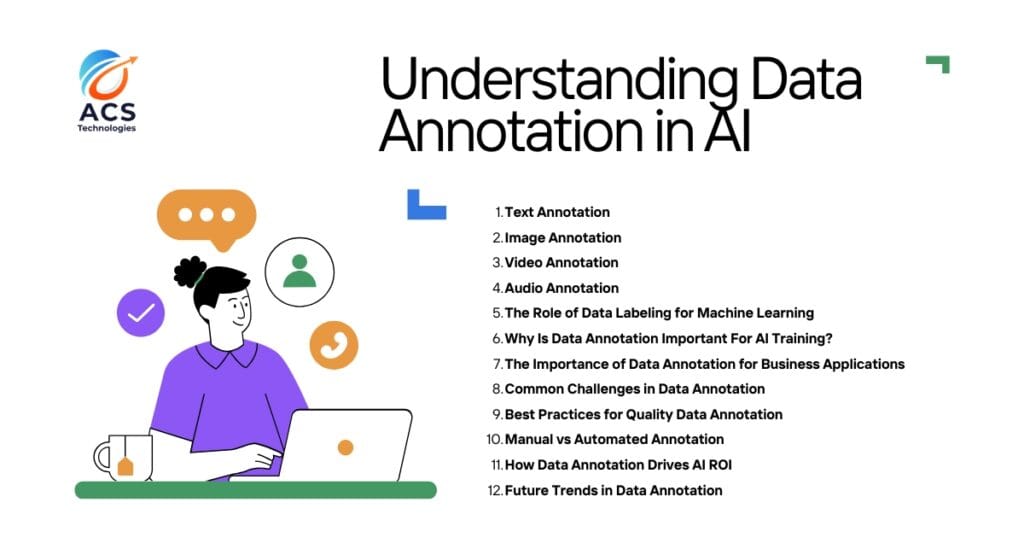
Types of Data Annotation
There are several sorts of data annotation, and the type utilized will be determined by the particular artificial intelligence job. Here are several sorts of data annotations:
- Text Annotation
Text annotation is the most prevalent sort, particularly in natural language processing. In natural language processing, text annotation entails marking the following sorts of text:
- Named entities
- Sentiment
- Intent classification
- Parts of speech
- Keywords tagging
- Image Annotation
Image annotation is the most common sort, particularly in the area of computer vision. In computer vision, picture annotation entails naming the following sort of images:
- Bounding boxes
- Polygon segmentation
- Landmark annotation
- Image classification
- Facial recognition labeling
- Video Annotation
Items and activities in video annotation are monitored over several frames, allowing you to determine what’s going on and how items are moving. Video annotation helps in:
- Action recognition
- Motion tracking
- Autonomous vehicle navigation
- Surveillance
In video annotation, there are various pieces of information that are layered, making it essential to be precise and accurate.
- Audio Annotation
In audio annotation, there are various processes, including speech transcription, speaker identification, and emotion tagging. Audio annotation is essential for:
- Voice assistants
- Automated transcription tools
- Call center analytics
- Accessibility technology
The Role of Data Labeling for Machine Learning
In machine learning, there are various processes that are learned, and data labeling helps in providing this information. In supervised learning, data sets are essential for training a model.
| As an example: Annotate each email as spam or ham to train a model to identify them.Annotating each product for flaws is necessary to train a model to identify them. |
In data labeling, algorithms are guided on what to look for and what to predict. When data is not accurately annotated, there are various consequences, including:
- Inaccurate predictions
- Bias in predictions
- Inefficient algorithms
- Higher retraining costs
Therefore, data labeling is not only important but also a crucial part of machine learning.
Why Is Data Annotation Important For AI Training?
- Enables pattern recognition
Artificial intelligence models are pattern recognition systems. They examine labeled instances to find correlations. Without labeled data, there are no patterns to learn from.
- Improves model accuracy
The quality of annotation directly affects AI performance. High-quality data enhances:
- Precision recall
- Model’s courage
- Decision reliability
The clearer the labeling, the more intelligent the model.
- Minimizes bias and ethical risks
The value of data annotation extends beyond justice and ethics. Carefully chosen datasets decrease:
- Cultural prejudice
- Gender bias
- Language prejudice
- Sampling bias
Diverse annotation teams and quality control techniques assist in keeping datasets balanced.
- Speeds up AI development
Well-annotated datasets save time on troubleshooting and retraining. Efficient labeling processes enable firms to:
- Launch AI products more quickly.
- Improve the time to market.
- Lower development expenses.
- Enhances Scalability
As AI models grow, regular annotation assures scalability. Structured procedures help businesses to expand datasets while maintaining quality.
The Importance of Data Annotation for Business Applications
Understanding theimportance of data annotation enables firms to match AI plans with business objectives.
- Healthcare
Annotated medical pictures improve the accuracy with which cancers, fractures, and abnormalities are detected.
- Retail
Product tagging enhances recommendation engines and search results.
- Automotive
Self-driving vehicles rely on properly labeled road signs, pedestrians, and traffic lights.
- Finance
Transaction tagging helps fraud detection models.
Across sectors, annotation is the secret motor that drives innovation.
Common Challenges in Data Annotation
Despite its importance, data annotation poses various challenges:
- Maintaining Quality at Scale
Maintaining accuracy gets more difficult as datasets increase in size. Inconsistent labeling may reduce model performance.
- Domain Knowledge Requirements
Certain sectors need subject-matter specialists to guarantee accurate labeling.
- Time-intensive Processes
Manual annotating may be resource-intensive without improved methods.
- Data Privacy Concerns
Sensitive data must be treated carefully throughout the annotating process.
To overcome these problems, established mechanisms and expert monitoring are required.
Best Practices for Quality Data Annotation
Enterprises should use the following best practices in order to maximize the outcomes of artificial intelligence:
- Establish clear guidelines
Create annotation guides outlining labeling guidelines and edge situations.
- Implement multi-level review systems
Peer review and consensus-building procedures promote consistency.
- Use advanced annotating tools
Modern systems provide collaboration, automation, and version control.
- Ensure data set diversity
Diverse samples reduce bias and improve model generalization.
- Continuous review loops
Models should be modified using better labels to improve performance.
Manual vs Automated Annotation
As the size of the data grows, businesses may turn to the use of automation.
| Manual Annotation | Automated Annotation |
| High accuracy | Faster annotation |
| Human judgment | Human judgment |
| Understanding the context | Understanding the context |
How Data Annotation Drives AI ROI
The value of AI is realized when models perform reliably. Let’s dissect the ROI calculation for AI systems:
- Reduced training iterations means cost savings.
- Accurate models mean happier customers.
- Predictions that can be trusted mean better decisions.
- Accelerated deployment means increased competitive advantage.
Data annotation is not just about preparation; it’s about extracting performance from your AI systems.
Future Trends in Data Annotation
As we look forward to the future of data annotation, the scene is changing with the growing use of AI technologies. New models of data annotation are being developed:
- AI-aided data annotation tools
- Synthetic data creation
- Active learning systems
- Data annotation tools with crowdsourcing
- Better quality control systems
The future of AI will depend on the availability of data that is not only scalable but also precise and ethical.
Conclusion
As the world of AI continues to revolutionize the way we run businesses, understanding what data annotation is all about is no longer optional but necessary. The true strength of AI is not in the flash of the algorithm but in the quality of the data used in the algorithm. The quality of data used in machine learning data labeling is what will ultimately define the quality of the machine learning algorithm, hence the need for data annotation.
When data annotation is recognized as a strategic business need, businesses can expect to reap the rewards of a competitive advantage in the marketplace. At ACS Technologies, we offer data annotation services that focus on the quality, consistency, and scalability of the data annotation process.